
Many taxpayers are shocked to learn that when a lender forgives a debt, the IRS may treat that forgiven amount as taxable income. Credit card settlements, foreclosures, medical debt forgiveness, and personal loan write-offs can all trigger unexpected tax consequences.
However, federal tax law provides important exceptions—especially for taxpayers who are bankrupt or insolvent.
This article explains how canceled debt is taxed, when it can be excluded, and what IRS regulations require you to report. For common real-world mistakes and IRS notice issues, see our separate guide on forgiven debt outside bankruptcy.
What Is Cancellation of Debt Income?
Under federal tax law, canceled or forgiven debt is generally considered income.
Internal Revenue Code §61(a)(11)
The Internal Revenue Code defines gross income to include:
“Income from discharge of indebtedness.”
— IRC §61(a)(11)
This means that if a lender releases you from paying a debt, the IRS may treat that forgiven balance as if you received cash.
Common Examples
Cancellation of debt (COD) income may arise from:
- Credit card settlements
- Mortgage foreclosures
- Repossessed vehicles
- Medical debt forgiveness
- Personal loan settlements
- Short sales
- Debt workout agreements
If $15,000 of debt is forgiven, that $15,000 may be taxable income.
Form 1099-C: How the IRS Learns About Forgiven Debt
When a creditor forgives $600 or more of debt, they generally must issue:
Form 1099-C – Cancellation of Debt
Treasury Regulation §1.6050P-1
Federal regulations require reporting when a “discharge of indebtedness” occurs:
“A discharge of indebtedness occurs when there is an identifiable event…”
— Treas. Reg. §1.6050P-1(b)(2)
Once issued, the IRS automatically receives a copy of the form.
Ignoring a 1099-C often leads to audits or CP2000 notices.
Major Exceptions: When Canceled Debt Is NOT Taxable
Congress recognized that taxing financially distressed taxpayers is unfair. As a result, several exclusions exist.
These rules are based on Internal Revenue Code §108 and related Treasury Regulations.
1. Bankruptcy Exclusion (IRC §108(a)(1)(A))
Debt discharged in bankruptcy is excluded from income.
Statutory Rule
“Gross income does not include… any amount which would be includible… if the discharge occurs in a title 11 case.”
— IRC §108(a)(1)(A)
Requirements
To qualify:
- The debt must be discharged
- In a federal bankruptcy case
- Under Title 11 of the U.S. Code
Both Chapter 7 and Chapter 13 cases usually qualify.
No insolvency calculation is required if this applies.
2. Insolvency Exclusion (IRC §108(a)(1)(B))
If you were insolvent when the debt was forgiven, you may exclude some or all of the income.
Definition of Insolvency
Treasury regulations define insolvency as:
“The excess of liabilities over the fair market value of assets.”
— Treas. Reg. §1.108-2
In simple terms:
You are insolvent if you owe more than you own.
Example
Assets: $80,000
Debts: $110,000
Insolvency: $30,000
If $25,000 is forgiven → fully excluded
If $40,000 is forgiven → $30,000 excluded, $10,000 taxable
3. Qualified Principal Residence Indebtedness
Certain mortgage forgiveness may be excluded under special provisions.
While limited after 2020, Congress has extended these rules periodically.
Always verify current eligibility.
4. Qualified Farm and Business Debt
IRC §108 also excludes certain:
- Farm indebtedness
- Real property business debt
These rules are technical and require careful analysis.
How to Claim an Exclusion: Form 982
If you qualify for any exclusion, you must file:
Form 982 – Reduction of Tax Attributes Due to Discharge of Indebtedness
Treasury Regulation §1.108-7
The regulations require taxpayers to properly elect exclusions:
“A taxpayer must attach Form 982 to the return…”
— Treas. Reg. §1.108-7
Failing to file Form 982 often causes the IRS to treat excluded income as taxable.
Attribute Reduction: The Hidden Trade-Off
Excluding canceled debt is not “free.”
IRC §108(b) requires taxpayers to reduce certain tax benefits.
These include:
- Net operating losses
- Capital loss carryovers
- Depreciation basis
- Tax credits
- Asset basis
This prevents “double benefits.”
Many taxpayers miss this step and create future compliance problems.
When Forgiven Debt IS Still Taxable
Canceled debt remains taxable if:
- You were solvent
- No bankruptcy was involved
- No statutory exclusion applies
- Form 982 is not filed
Common taxable situations include:
- Credit card settlements while employed
- Personal loans forgiven by friends
- Business debts without insolvency
- Private debt workouts
These often surprise taxpayers at filing time.
Practical Example
Sarah settles $20,000 in credit card debt for $6,000.
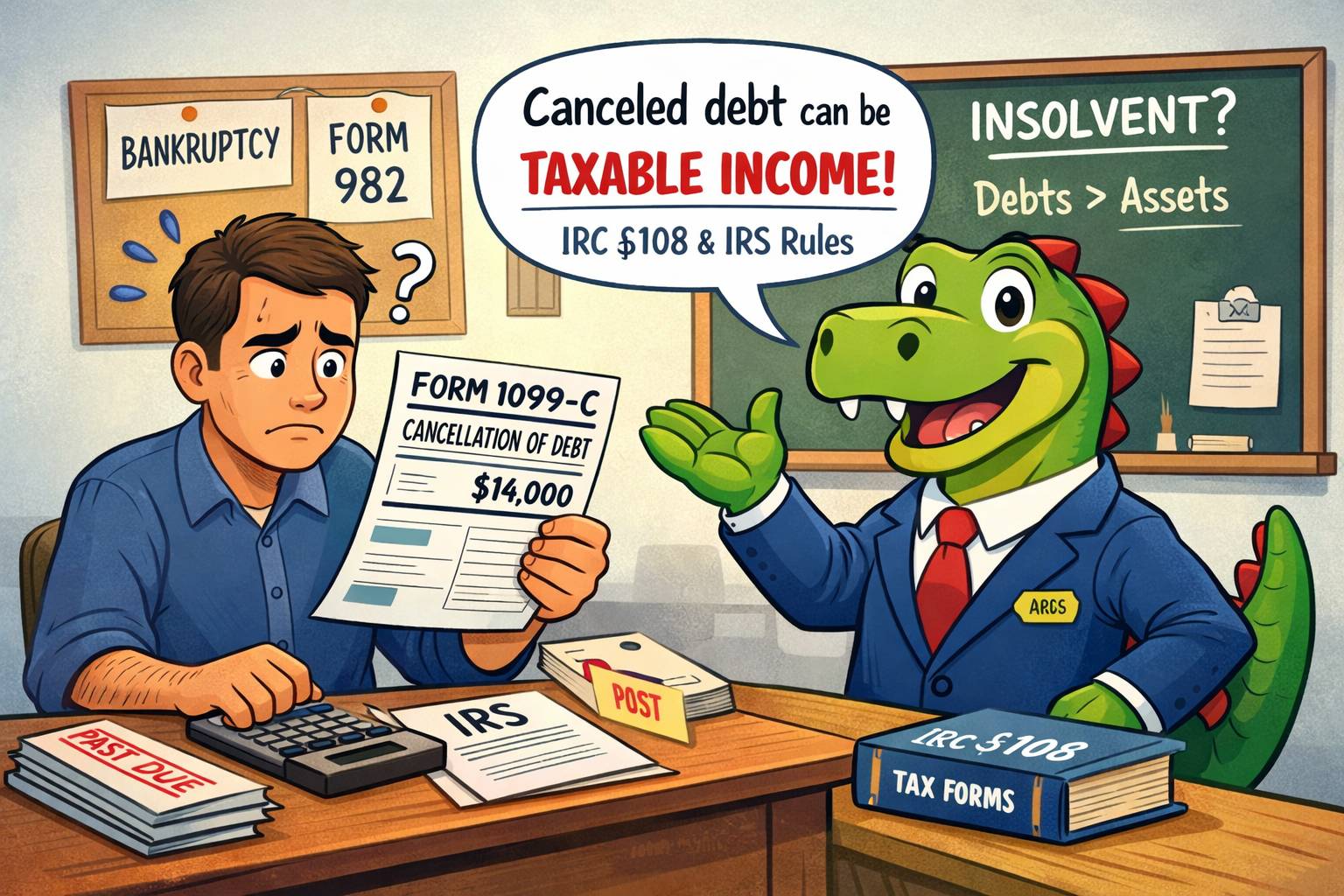
She receives a 1099-C for $14,000.
At the time:
Assets: $50,000
Debts: $70,000
Insolvency: $20,000
Result:
$14,000 is fully excluded
She files Form 982
No taxable income arises
Without Form 982, the IRS would assess tax on $14,000.
Common Mistakes with Canceled Debt
Many taxpayers run into problems by:
❌ Ignoring 1099-C forms
❌ Failing to calculate insolvency
❌ Skipping Form 982
❌ Misvaluing assets
❌ Forgetting retirement accounts count as assets
❌ Overlooking attribute reductions
These mistakes often trigger audits.
Why Professional Advice Matters
Cancellation of debt issues combine:
- Income tax law
- Bankruptcy law
- Accounting rules
- IRS reporting regulations
Small errors can create thousands in unnecessary taxes and penalties.
If you have multiple 1099-Cs, business debts, or asset complications, professional guidance is critical.
Final Thoughts
Canceled debt is not automatically taxable—but it is automatically scrutinized.
Federal law provides powerful relief through IRC §108, but only if you:
- Understand the exclusions
- Document insolvency properly
- File Form 982 correctly
- Apply attribute reductions
Handled properly, forgiven debt does not have to create new financial hardship.
Handled poorly, it can.
At Dino Tax Co, we help clients navigate tax matters ranging from unfiled returns to IRS letters and levies and everything in between with clarity and confidence. If you’d like guidance on your situation, schedule a consultation today. Call or text (713) 397-4678 or email davie@dinotaxco.com. We’re here to help you take the next step.

Leave A Comment