
Many employees receive benefits from their employers beyond a paycheck. These benefits may include company vehicles, professional memberships, continuing education, cell phones, business travel, and specialized equipment. While many fringe benefits are taxable, federal tax law provides an important exception for certain employer-provided benefits that are primarily business-related.
These benefits are known as working condition fringe benefits, and they are governed by Internal Revenue Code § 132(d).
Understanding this rule can help both employers and employees avoid unexpected tax consequences while maximizing legitimate tax-free benefits.
What Is a Working Condition Fringe Benefit?
IRC § 132(d) provides:
“The term ‘working condition fringe’ means any property or services provided to an employee of the employer to the extent that, if the employee paid for such property or services, such payment would be allowable as a deduction under section 162 or 167.”
In plain English, a benefit may be excluded from an employee’s taxable income if the employee could have deducted the expense as an ordinary and necessary business expense had they paid for it personally.
The tax law effectively says that if the expense is genuinely business-related, the employer’s payment of that expense should not generally create taxable compensation.
Treasury Regulations Provide Additional Guidance
Treasury Regulation § 1.132-5(a)(1) explains:
“Gross income does not include the value of a working condition fringe provided by an employer to an employee.”
The regulation further explains that the exclusion applies only to the extent the property or service is related to the employee’s trade or business as an employee.
This means personal use generally remains taxable even if business use is tax-free.
Common Examples of Working Condition Fringe Benefits
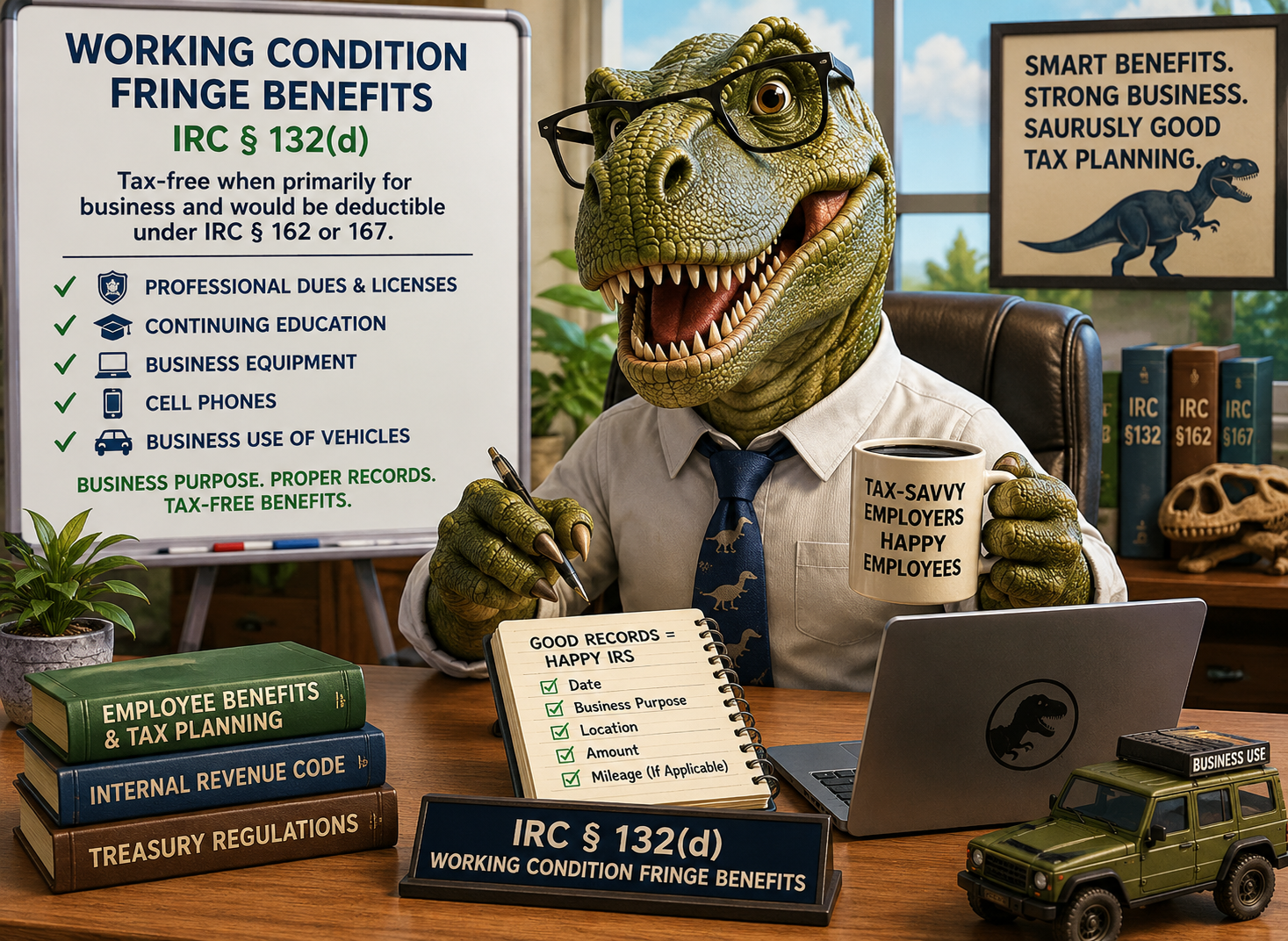
Professional Licenses and Dues
An employer may pay for:
- State professional licenses
- Bar dues
- CPA license fees
- Industry certifications
- Continuing professional education
If the expense relates to the employee’s job duties and would otherwise qualify as a business expense, the payment may generally be excluded from taxable wages.
Employer-Provided Cell Phones
Employer-provided cell phones are often treated as working condition fringe benefits when furnished primarily for noncompensatory business reasons.
Examples include:
- Employees who must remain reachable after hours
- Sales personnel who travel extensively
- Managers who coordinate operations remotely
Business use is generally tax-free, while purely personal arrangements may create taxable income.
Business Equipment
Employers frequently provide:
- Computers
- Laptops
- Tablets
- Specialized tools
- Technical equipment
When used primarily for business purposes, the value of the equipment generally qualifies for exclusion under IRC § 132(d).
Continuing Education
Employers may pay for seminars, training programs, and professional education that maintains or improves skills required in an employee’s current position.
When the expense would otherwise qualify as a deductible business expense, the employee generally does not recognize taxable income from the employer’s payment.
Employer-Provided Vehicles
One of the most heavily scrutinized working condition fringe benefits involves company vehicles.
Business use of an employer-provided vehicle may qualify for exclusion under IRC § 132(d).
However, personal use remains taxable.
For example:
- Driving from one client site to another generally constitutes business use.
- Driving to the grocery store generally constitutes personal use.
- Certain commuting arrangements may receive special treatment under separate rules.
Employers often maintain mileage logs to substantiate business use percentages.
The Importance of Substantiation
Treasury Regulation § 1.132-5(c) requires substantiation in many circumstances.
Employees and employers should maintain records showing:
- Date of use
- Business purpose
- Location
- Amount of expense
- Mileage where applicable
Without adequate substantiation, the IRS may treat the benefit as taxable compensation.
Interaction with Employee Business Expense Rules
Prior to the Tax Cuts and Jobs Act, many employees could claim unreimbursed employee business expenses as miscellaneous itemized deductions.
The TCJA largely suspended those deductions for many taxpayers through 2025.
However, working condition fringe benefits remain valuable because they allow employers to provide qualifying business benefits tax-free even when employees may no longer deduct the same expenses themselves.
Common IRS Audit Issues
The IRS frequently examines:
- Company vehicles
- Mixed personal/business use property
- Executive perks
- Professional memberships
- Employer-paid education
Problems typically arise when taxpayers fail to distinguish between personal and business use or lack adequate documentation.
Practical Takeaways
Working condition fringe benefits represent one of the most useful employee tax exclusions in the Internal Revenue Code. Properly structured benefits can provide substantial value without increasing taxable wages.
Employees should maintain records demonstrating the business purpose of employer-provided property and services. Employers should establish clear policies and retain supporting documentation.
When properly documented, working condition fringe benefits can create a legitimate win-win situation for both employers and employees by allowing necessary business expenses to be provided without triggering additional federal income tax.
Conclusion
IRC § 132(d) provides an important exclusion for employer-provided property and services that would otherwise qualify as deductible business expenses if paid directly by the employee. Professional dues, business equipment, cell phones, continuing education, and business use of employer vehicles often fall within this category.
Because personal use can create taxable income, proper recordkeeping remains essential. Employers and employees who understand the working condition fringe benefit rules can often reduce tax exposure while ensuring compliance with federal tax law.
Disclaimer: This article is for informational purposes only and does not constitute legal, tax, or accounting advice. Tax laws change frequently, and taxpayers should consult a qualified tax professional regarding their specific circumstances.
At Dino Tax Co, we help clients navigate tax matters ranging from unfiled returns to IRS letters and levies and everything in between with clarity and confidence. If you’d like guidance on your situation, schedule a consultation today. Call or text (713) 397-4678 or email davie@dinotaxco.com. We’re here to help you take the next step.

Leave A Comment