
Adoption Is Expensive — But the Tax Code Provides Relief
Adopting a child can be one of the most rewarding experiences in life, but it can also be costly. Legal fees, agency costs, travel expenses, court filings, and other adoption-related expenses can quickly add up to thousands of dollars.
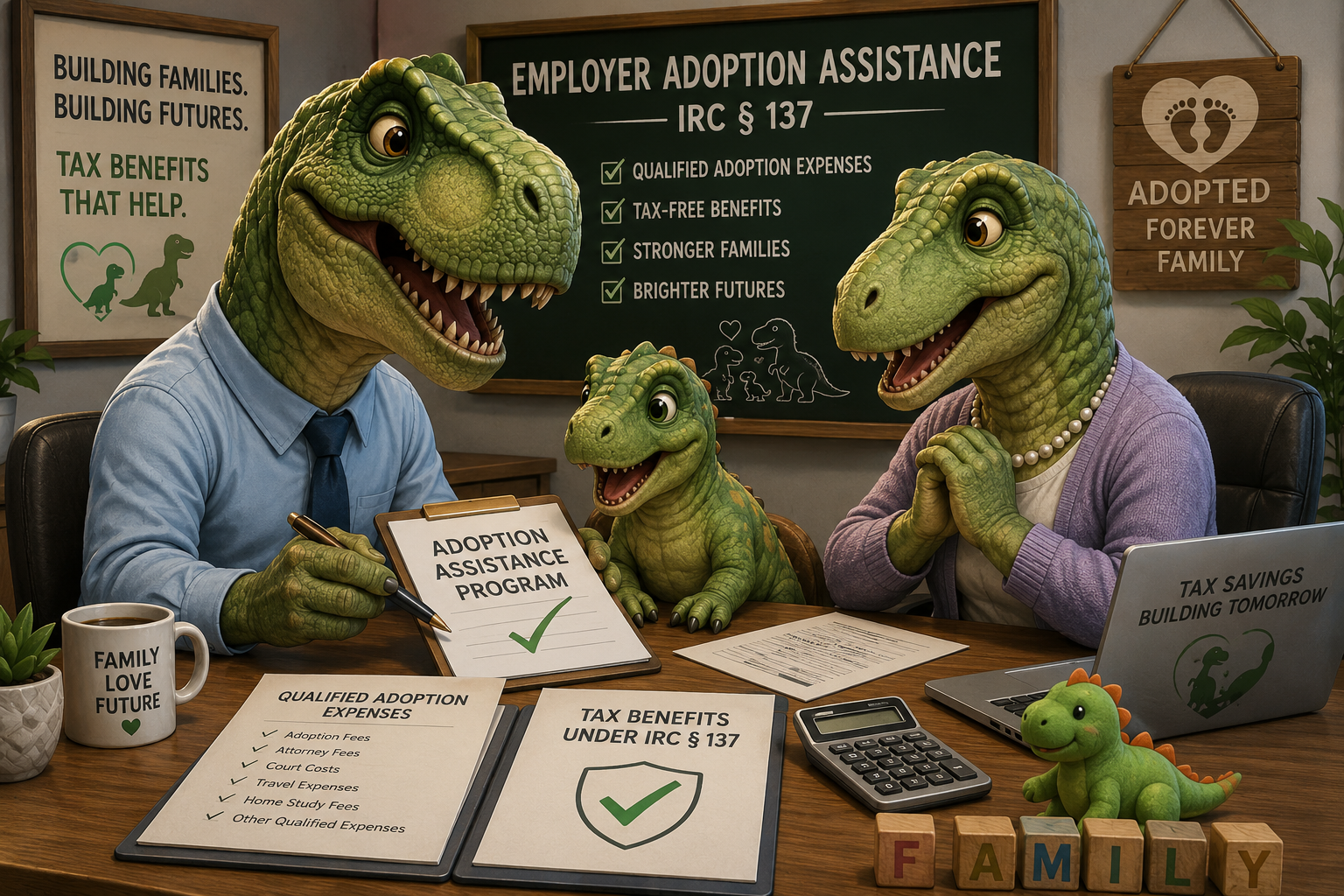
Many employers offer adoption assistance programs to help employees with these expenses. What many taxpayers do not realize is that a portion of these employer-provided benefits may be excluded from taxable income under federal law.
Understanding how Internal Revenue Code § 137 works can help employees maximize available tax benefits and avoid unexpected tax consequences.
What Is Employer Adoption Assistance?
Employer adoption assistance generally consists of payments or reimbursements made by an employer to help an employee pay qualified adoption expenses.
Congress created a special tax benefit allowing certain employer-provided adoption assistance to be excluded from an employee’s gross income.
The governing statute provides:
“Gross income of an employee does not include amounts paid or expenses incurred by the employer for qualified adoption expenses furnished pursuant to an adoption assistance program.”
— IRC § 137(a)
In simple terms, qualifying adoption assistance can often be received completely free from federal income tax.
What Is an Adoption Assistance Program?
The Internal Revenue Code requires the benefit to be provided through an employer adoption assistance program.
IRC § 137(c) defines an adoption assistance program as a separate written plan of an employer that satisfies certain statutory requirements, including nondiscrimination requirements and reasonable notice to eligible employees.
Employers cannot simply reimburse adoption expenses informally and expect the exclusion to apply.
What Expenses Qualify?
Qualified adoption expenses generally include reasonable and necessary expenses directly related to the legal adoption of an eligible child.
Treasury Regulations provide additional guidance.
Treasury Regulation § 1.137-1(d) states:
“Qualified adoption expenses are reasonable and necessary adoption fees, court costs, attorney fees, traveling expenses (including amounts expended for meals and lodging while away from home), and other expenses directly related to, and for the principal purpose of, the legal adoption of an eligible child.”
Examples may include:
- Adoption agency fees
- Court filing fees
- Attorney fees
- Home study costs
- Required travel expenses
- Lodging associated with adoption proceedings
What Expenses Do Not Qualify?
Not every adoption-related expenditure qualifies.
Expenses generally do not qualify if they are:
- Reimbursed from another source
- Violating state or federal law
- Related to a surrogate parenting arrangement
- Related to adopting a spouse’s child
Treasury Regulation § 1.137-2 specifically excludes certain categories of expenses from favorable treatment.
Income Limitations Apply
Like many family-oriented tax benefits, Congress imposed income limitations.
The exclusion begins to phase out for higher-income taxpayers.
Taxpayers whose modified adjusted gross income exceeds the applicable threshold may receive a reduced exclusion, and the benefit eventually phases out entirely at higher income levels.
Because the threshold is adjusted periodically for inflation, taxpayers should verify the current year’s limits before filing.
How Is the Benefit Reported?
Employer-provided adoption assistance is often reported on Form W-2.
However, qualifying amounts may still be excluded from federal taxable income if all requirements are met.
Employees claiming the exclusion generally complete Form 8839, Qualified Adoption Expenses, when preparing their federal income tax return.
The form calculates both:
- The exclusion for employer-provided adoption assistance; and
- The separate adoption tax credit, if applicable.
Can Taxpayers Receive Both the Exclusion and the Adoption Credit?
Potentially, yes—but not for the same expenses.
The Internal Revenue Code generally prevents taxpayers from receiving a double tax benefit.
Expenses used to calculate the exclusion cannot also be used to calculate the adoption credit.
Careful recordkeeping is important to maximize available benefits while remaining compliant with IRS rules.
Common Mistakes Taxpayers Make
Several issues frequently arise:
Assuming All Adoption Expenses Are Tax-Free
Only qualifying expenses paid through a qualifying program are eligible for exclusion.
Double Counting Expenses
The same expense generally cannot be used for both the exclusion and the adoption credit.
Ignoring Income Phaseouts
Higher-income taxpayers may be surprised to discover that the exclusion has been reduced or eliminated.
Poor Documentation
Taxpayers should maintain records showing:
- Agency invoices
- Court costs
- Attorney bills
- Travel receipts
- Employer reimbursement records
Documentation can be critical if the IRS later requests support for the exclusion.
Why This Matters
Adoption can place a significant financial burden on families. Congress has long recognized this reality by providing both an adoption tax credit and favorable treatment for employer-provided adoption assistance.
Understanding IRC § 137 may allow qualifying taxpayers to receive thousands of dollars in employer assistance without increasing their federal income tax liability.
As with many tax benefits, the details matter. Proper planning and documentation can make the difference between a valid tax-free benefit and an expensive tax problem.
Final Thoughts
Employer-provided adoption assistance remains one of the lesser-known tax benefits available to working families. When structured correctly through a qualifying adoption assistance program, these benefits may be excluded from federal taxable income under IRC § 137. Employees considering adoption should review their employer’s benefit programs and consult a qualified tax professional to ensure they properly claim all available exclusions and credits.
At Dino Tax Co, we help clients navigate tax matters ranging from unfiled returns to IRS letters and levies and everything in between with clarity and confidence. If you’d like guidance on your situation, schedule a consultation today. Call or text (713) 397-4678 or email davie@dinotaxco.com. We’re here to help you take the next step.

Leave A Comment