How IRC § 6672 Can Make You Personally Liable for Payroll Taxes
If you own a small business in Texas — or anywhere in the United States — payroll taxes are not just another line item. They are a fiduciary obligation. When an employer withholds federal income tax and FICA from an employee’s paycheck, that money does not belong to the business.
It belongs to the United States.
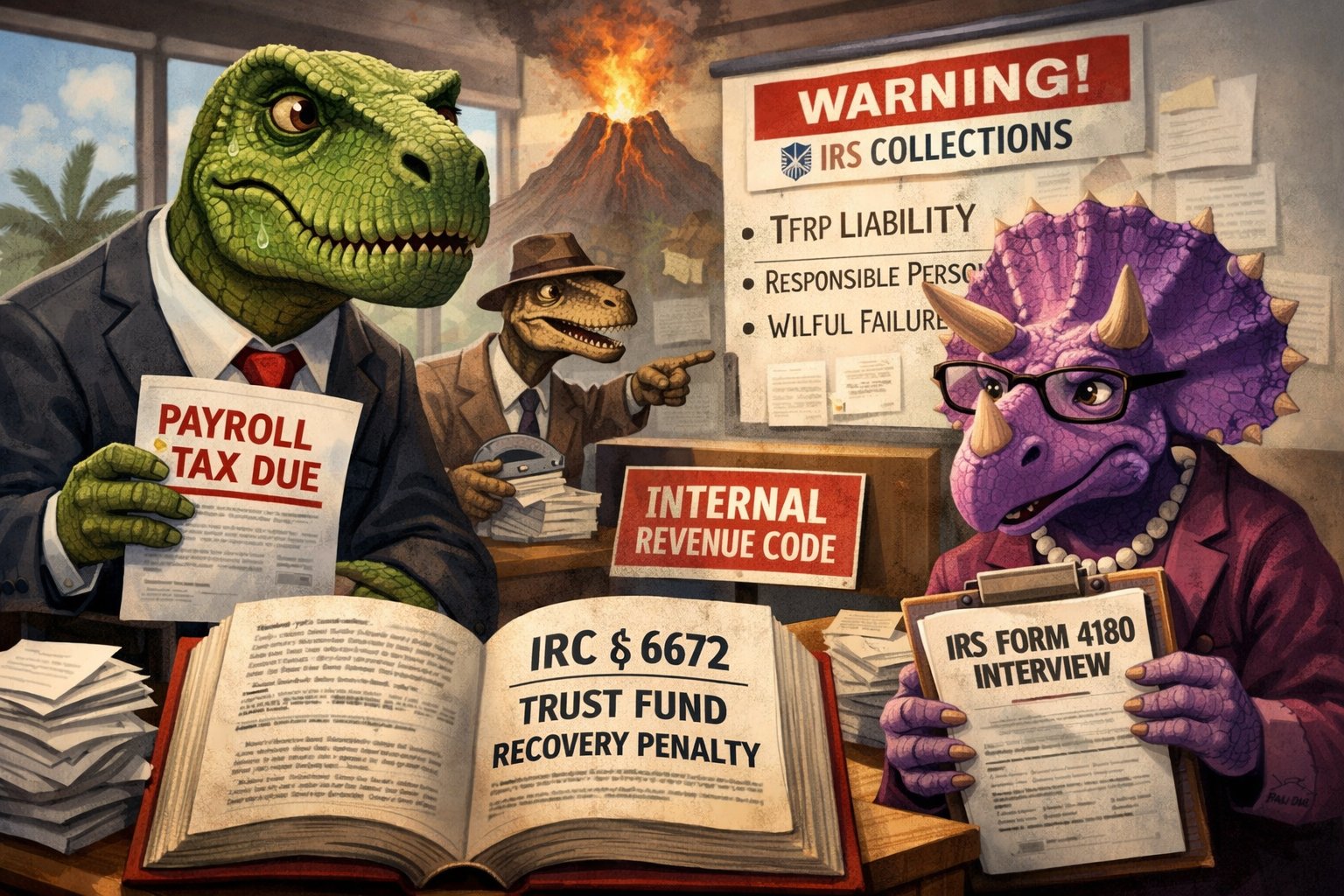
When those withheld taxes are not paid over to the IRS, the government has one of the most aggressive collection tools in the Internal Revenue Code: the Trust Fund Recovery Penalty (TFRP) under IRC § 6672.
This topic does not appear on your current index and is highly relevant to business owners, corporate officers, LLC managers, and even bookkeepers.
Let’s break it down.
1. What Are “Trust Fund Taxes”?
Under IRC § 7501(a):
“Whenever any person is required to collect or withhold any internal revenue tax from any other person and to pay over such tax to the United States, the amount so collected or withheld shall be held to be a special fund in trust for the United States.”
These are called trust fund taxes because the employer holds them in trust.
They include:
- Federal income tax withholding
- Employee portion of Social Security
- Employee portion of Medicare
Importantly, the employer’s matching share of FICA is not part of the trust fund portion. The penalty applies only to the withheld amounts.
2. The Personal Liability Statute – IRC § 6672
Here is the critical provision.
IRC § 6672(a) provides:
“Any person required to collect, truthfully account for, and pay over any tax imposed by this title who willfully fails to collect such tax, or truthfully account for and pay over such tax… shall… be liable to a penalty equal to the total amount of the tax evaded, or not collected, or not accounted for and paid over.”
In plain English:
If you were responsible for payroll taxes and you willfully failed to pay them, the IRS can assess the unpaid trust fund taxes against you personally.
Even if:
- The business is an LLC
- The corporation has been dissolved
- The company filed bankruptcy
- You were not the majority owner
Limited liability does not protect against § 6672.
3. Who Is a “Responsible Person”?
The IRS looks at control, not job title.
A “responsible person” is someone who had the authority to:
- Sign checks
- Control payroll
- Decide which creditors get paid
- Direct financial decisions
Courts consider factors such as:
- Check-signing authority
- Ownership interest
- Power to hire and fire
- Control over bank accounts
- Ability to determine creditor priority
You do not have to be the CEO. Bookkeepers, payroll managers, and minority owners have all been assessed.
4. What Does “Willful” Mean?
“Willful” does not require evil intent.
Courts interpret willfulness as:
- Knowing the taxes were due, and
- Choosing to pay other creditors instead
If you paid:
- Vendors
- Landlords
- Yourself
- Credit cards
while knowing payroll taxes were unpaid, that can satisfy willfulness.
Even reckless disregard can qualify.
5. How the IRS Assesses the Penalty
The IRS process typically includes:
- Payroll tax delinquency identified
- Revenue Officer assigned
- Interviews conducted (Form 4180 interview)
- Proposed assessment (Letter 1153)
- Opportunity to appeal
If assessed, the liability becomes your personal tax debt.
The IRS can then:
- File a federal tax lien
- Levy bank accounts
- Garnish wages
- Seize assets
This is separate from the company’s liability.
6. Joint and Several Liability
Multiple people can be assessed for the same payroll tax debt.
The government may pursue:
- The owner
- The CFO
- The office manager
All for the same trust fund amount.
The IRS only needs to collect once — but they can pursue everyone until paid.
7. Bankruptcy Does Not Automatically Fix This
Trust fund taxes are generally nondischargeable under 11 U.S.C. § 523(a)(1). Even corporate bankruptcy does not eliminate personal TFRP exposure.
This is why payroll compliance must be treated as non-negotiable.
8. Why This Matters for Texas Business Owners
As a licensed attorney and tax professional, I regularly see situations where:
- Cash flow is tight
- The business “borrows” from payroll taxes
- Owners assume the LLC protects them
It does not.
The Trust Fund Recovery Penalty is one of the most aggressive enforcement tools in federal tax law. The IRS views withheld payroll taxes as money taken from employees and held in trust.
The government treats failure to remit these funds as a serious breach of duty.
9. How to Protect Yourself
- Never use withheld payroll taxes for operating expenses
- Use a reputable payroll processor
- Monitor EFTPS confirmations
- Document delegation of authority carefully
- Seek professional advice immediately if payroll taxes fall behind
If you receive Letter 1153 or are asked to complete a Form 4180 interview, do not ignore it.
Early intervention matters.
Conclusion
The Trust Fund Recovery Penalty under IRC §§ 7501 and 6672 transforms payroll tax problems into personal financial disasters.
LLCs and corporations provide liability protection for many risks — but not for unpaid trust fund taxes.
If you own or manage a business in Texas and are facing payroll tax issues, address it immediately. The longer it sits, the more personal the exposure becomes.
At Dino Tax Co, we help clients navigate tax matters ranging from unfiled returns to IRS letters and levies and everything in between with clarity and confidence. If you’d like guidance on your situation, schedule a consultation today. Call or text (713) 397-4678 or email davie@dinotaxco.com. We’re here to help you take the next step.

Leave A Comment