
Introduction
Many investors believe they can reduce taxes by realizing losses while keeping upside exposure in similar positions. However, the IRS anticipated this strategy decades ago and enacted Internal Revenue Code § 1092, commonly known as the straddle rules.
These rules can defer losses, recharacterize gains, and create unexpected tax consequences—especially for options traders, hedge strategies, and sophisticated investors.
If you trade stocks, options, or other securities, understanding straddles is essential to avoiding costly surprises.
What Is a “Straddle” Under Tax Law?
Under IRC § 1092(c)(1):
“The term ‘straddle’ means offsetting positions with respect to personal property.”
In plain English, a straddle exists when you hold two or more positions that substantially reduce your risk of loss.
Common Examples
- Buying a stock and purchasing a put option on the same stock
- Holding a stock while shorting a substantially identical security
- Entering into offsetting futures or options contracts
The Core Problem: Loss Deferral
The primary purpose of § 1092 is to prevent taxpayers from harvesting losses while maintaining economic exposure.
Key Rule – Loss Deferral
Under IRC § 1092(a)(1):
“Any loss with respect to one or more positions of a straddle shall be allowed only to the extent that such loss exceeds the unrecognized gain… on offsetting positions.”
What This Means
- You cannot deduct losses immediately if you still hold an offsetting position with unrealized gains
- Losses are deferred until the offsetting position is closed
Holding Period Consequences
Straddles also impact capital gain classification.
Under IRC § 1092(d)(2) and related provisions:
- Holding periods may be suspended
- Long-term capital gain treatment can be lost or delayed
👉 This can convert what you thought would be long-term gains into short-term gains, increasing your tax rate.
Capitalization of Carrying Costs
Another hidden issue is interest and carrying costs.
Under IRC § 263(g):
Certain interest and carrying charges related to personal property that is part of a straddle must be capitalized.
Translation
- You cannot deduct margin interest immediately
- Instead, those costs are added to basis and recognized later
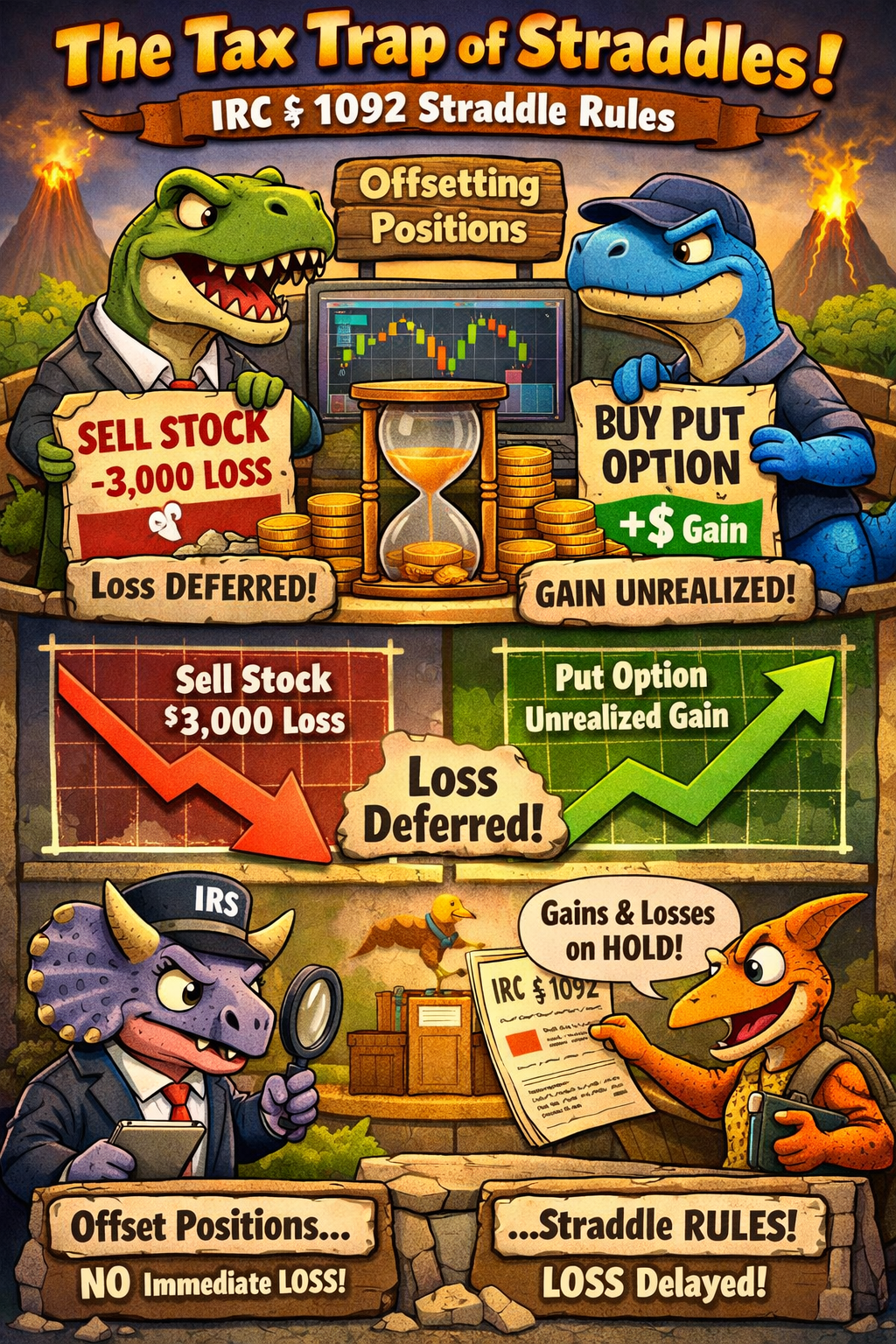
Real-World Example
Scenario:
- Investor buys stock for $10,000
- Purchases a protective put
- Stock drops to $7,000
- Investor sells stock (realizing $3,000 loss) but keeps the put
Result:
- Loss is deferred under § 1092
- No immediate tax benefit
- Loss becomes usable only when the offsetting position is closed
Why This Matters for Everyday Investors
With the rise of:
- Robinhood-style trading
- Options strategies
- Retail hedging
…many taxpayers are unknowingly triggering straddle rules.
Even simple “risk management” strategies can:
- Delay losses
- Increase taxable income
- Complicate reporting
Planning Considerations
1. Close Both Legs
To recognize losses, you often must close all offsetting positions.
2. Watch for “Substantially Identical” Positions
The IRS looks at economic reality, not just labels.
3. Track Basis Carefully
Deferred losses and capitalized costs require precise tracking.
4. Coordinate With Wash Sale Rules
Straddles and wash sales can overlap, creating layered limitations.
Straddles vs. Wash Sale Rules
While both rules limit tax loss harvesting:
| Rule | Applies To | Key Effect |
| § 1091 (Wash Sale) | Repurchase of same/similar stock | Disallows loss |
| § 1092 (Straddle) | Offset positions | Defers loss |
👉 Straddles are often broader and more complex than wash sale rules.
Conclusion
The straddle rules under IRC § 1092 are one of the most overlooked tax traps for investors.
They:
- Prevent artificial loss harvesting
- Defer deductions
- Complicate capital gain treatment
If you or your clients are trading options, hedging positions, or using advanced strategies, these rules are not optional—they are critical to compliance and planning.
Why It Matters
Misunderstanding straddles can lead to:
- Unexpected tax bills
- IRS scrutiny
- Incorrect returns
A proactive tax strategy can help ensure:
- Proper timing of gains and losses
- Accurate reporting
- Maximized after-tax returns
At Dino Tax Co, we help clients navigate tax matters ranging from unfiled returns to IRS letters and levies and everything in between with clarity and confidence. If you’d like guidance on your situation, schedule a consultation today. Call or text (713) 397-4678 or email davie@dinotaxco.com. We’re here to help you take the next step.

Leave A Comment