
Introduction
In federal tax law, ownership is not always what it seems.
Even if a taxpayer does not directly own stock or an interest in a business, the IRS may treat them as if they do. This concept—known as constructive ownership—can dramatically affect tax consequences in areas such as:
- Stock redemptions
- Related-party transactions
- Corporate control determinations
- Loss disallowance rules
At the center of these rules is Internal Revenue Code § 318, one of the most powerful—and often overlooked—attribution provisions in the tax code.
What Is Constructive Ownership?
Constructive ownership means that a taxpayer is treated as owning property held by another person or entity under specific attribution rules.
These rules are codified in:
IRC § 318(a):
“For purposes of those provisions of this subchapter to which this section applies, stock owned, directly or indirectly, by or for a corporation, partnership, estate, or trust shall be considered as being owned proportionately by its shareholders, partners, or beneficiaries.”
In plain English:
👉 You may “own” stock for tax purposes even if it’s technically owned by someone else.
The Four Main Attribution Categories Under § 318
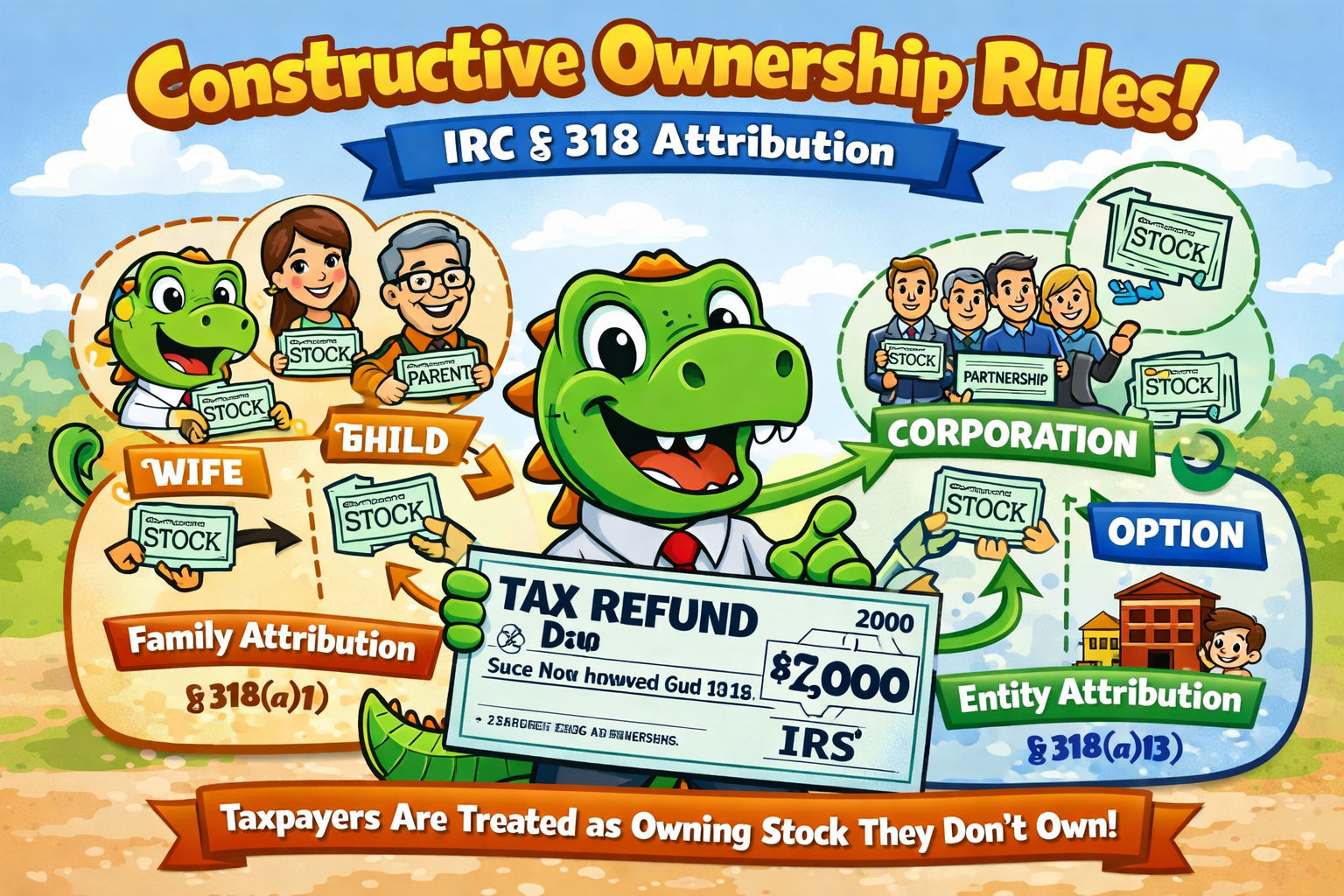
1. Family Attribution
Under § 318, an individual is treated as owning stock owned by:
- Their spouse
- Children
- Grandchildren
- Parents
IRC § 318(a)(1)(A):
“An individual shall be considered as owning the stock owned, directly or indirectly, by or for his spouse… children, grandchildren, and parents.”
🚨 Key Insight:
Siblings are NOT included—but almost everyone else in the immediate family is.
2. Entity-to-Owner Attribution
Ownership flows downward from entities to individuals.
IRC § 318(a)(2):
Stock owned by a corporation, partnership, estate, or trust is attributed proportionately to its owners.
Example:
- A partnership owns 100 shares
- You own 50% of the partnership
👉 You are treated as owning 50 shares
3. Owner-to-Entity Attribution
Ownership can also flow upward from individuals to entities.
IRC § 318(a)(3):
Stock owned by a shareholder, partner, or beneficiary may be attributed to the entity.
Example:
- You personally own stock
- You also own a corporation
👉 The corporation may be treated as owning your stock
4. Option Attribution
If you have the option to acquire stock, you are treated as owning it.
IRC § 318(a)(4):
“If any person has an option to acquire stock, such stock shall be considered as owned by such person.”
🚨 This is extremely broad:
- Call options
- Convertible securities
- Certain contractual rights
Why These Rules Matter (Real-World Impact)
1. Stock Redemptions (IRC § 302)
Whether a redemption is taxed as a sale (capital gain) or a dividend (ordinary income) often depends on ownership percentages—including constructive ownership.
👉 A taxpayer may think they reduced ownership…
…but attribution rules say otherwise.
2. Related-Party Transactions (IRC § 267)
Losses between related parties may be disallowed.
Constructive ownership can:
- Turn an unrelated party into a “related” one
- Disallow otherwise legitimate tax losses
3. Controlled Group Rules
Constructive ownership determines whether businesses are:
- Part of a controlled group
- Subject to aggregation rules
- Affected by shared limits (e.g., retirement plans, credits)
4. Estate and Gift Planning
Attribution rules can:
- Collapse planning strategies
- Cause unintended control or inclusion issues
- Affect valuation discounts
Common Trap: “I Don’t Own It—My Spouse Does”
This is one of the most frequent misunderstandings.
Under § 318:
👉 You DO own it (for tax purposes).
This can:
- Convert a capital gain into dividend income
- Trigger related-party rules
- Eliminate tax benefits
Advanced Trap: Double Attribution
Attribution rules can stack and compound.
Example:
- Parent owns stock
- Child is attributed ownership
- Child owns a corporation
👉 The corporation may now also be treated as owning the parent’s stock
This cascading effect can create unexpected control relationships.
Key Limitations and Exceptions
While § 318 is broad, it is not unlimited:
- Some provisions turn off attribution (e.g., certain redemption rules under § 302(c)(2))
- Attribution may not re-attribute in certain cases
- Specific Code sections modify or override § 318
👉 This is where careful planning becomes critical.
Why It Matters for Texas Business Owners
For your typical Houston-area client:
- Family-owned businesses are extremely common
- Informal ownership structures are everywhere
- Spouses and kids are often involved
That makes § 318 not theoretical—it’s everywhere.
Practical Takeaways
- Ownership is not just legal—it’s constructive
- Family relationships can change tax outcomes
- Entity structures can trigger hidden attribution
- Stock redemptions are especially dangerous
👉 If a transaction depends on ownership percentages,
you must analyze § 318 before doing anything.
Conclusion
Constructive ownership under IRC § 318 is one of the most powerful—and misunderstood—tools in the Internal Revenue Code.
It can:
- Recharacterize income
- Disallow losses
- Collapse planning strategies
- Create tax liability where none was expected
For taxpayers and advisors alike, ignoring attribution rules is not an option.
At Dino Tax Co, we help clients navigate tax matters ranging from unfiled returns to IRS letters and levies and everything in between with clarity and confidence. If you’d like guidance on your situation, schedule a consultation today. Call or text (713) 397-4678 or email davie@dinotaxco.com. We’re here to help you take the next step.

Leave A Comment