Understanding When the IRS Lets You Take Money Out Early—Without the Penalty
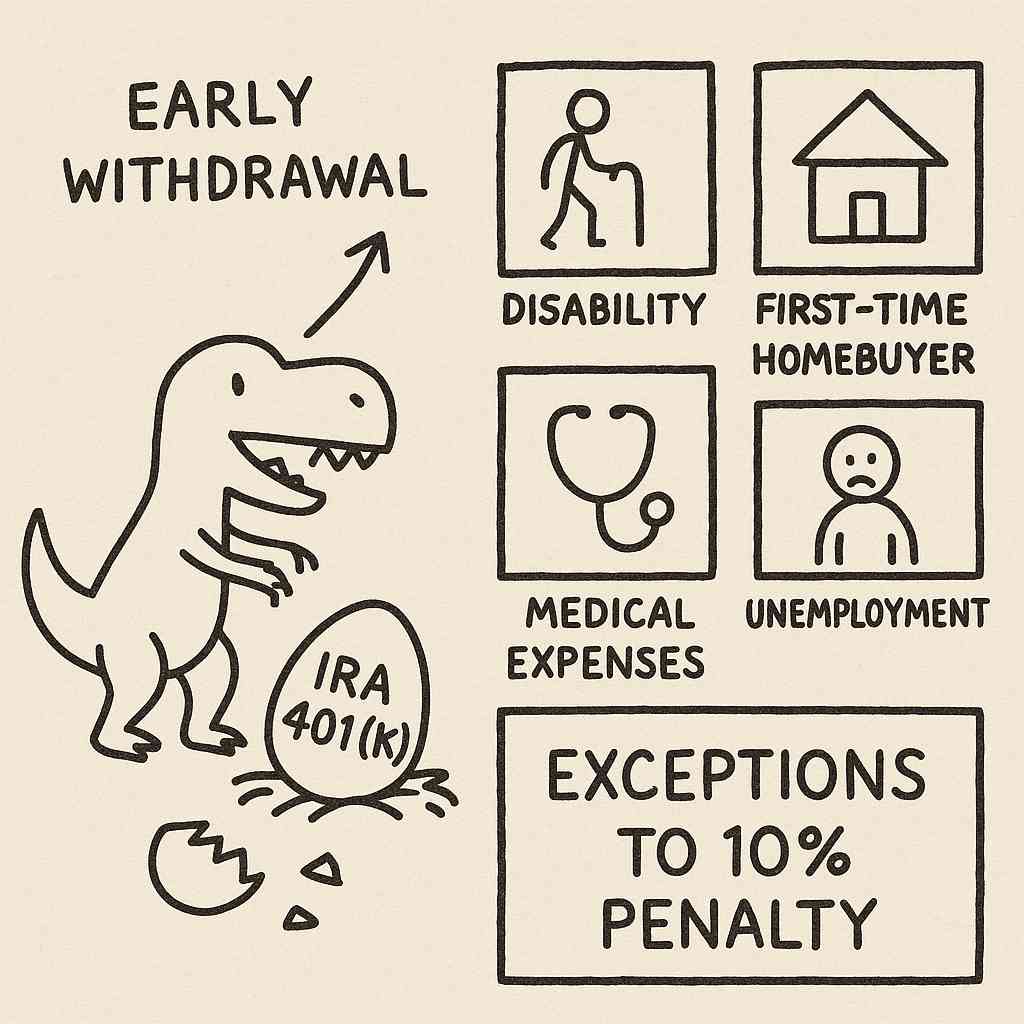
When you’re under age 59½, the IRS generally discourages taking money out of your retirement accounts by imposing a 10% early-distribution penalty on top of ordinary income tax. But life doesn’t always follow the rules—and the tax code recognizes that.
Fortunately, there are several exceptions that allow you to access IRA or 401(k) funds early without paying the 10% penalty. Whether you’ve lost a job, faced medical hardship, or need funds for education or a home, some relief may be available.
Below is a clear breakdown of the main exceptions, based on IRS rules and Publication 590-B/575.
1. Disability
If you become totally and permanently disabled, withdrawals from an IRA or 401(k) are penalty-free. You still owe income tax, but the 10% additional tax is waived.
2. Death
If the account owner dies, distributions to beneficiaries (including estate beneficiaries) are exempt from the 10% penalty.
3. Substantially Equal Periodic Payments (SEPP) – Rule 72(t)
This is a structured series of withdrawals—at least annually for 5 years or until age 59½, whichever is longer.
Once started, they must continue; modifying them early triggers retroactive penalties.
4. Medical Expenses (Over 7.5% of AGI)
If you paid unreimbursed medical expenses exceeding 7.5% of your adjusted gross income, you can withdraw that amount penalty-free from IRAs.
401(k)s may allow this only if you separated from service.
5. Health Insurance Premiums While Unemployed (IRA Only)
If you lose your job, you may withdraw IRA funds penalty-free to pay:
- Medical insurance for yourself
- Your spouse
- Your dependents
You must have received unemployment compensation for at least 12 consecutive weeks.
6. First-Time Homebuyer Exception (IRA Only)
Up to $10,000 lifetime, penalty-free, for buying/building/rebuilding a first home for:
- Yourself
- A spouse
- A child or grandchild
- A parent or other qualified relative
You still pay income tax, but no penalty.
7. Qualified Higher Education Expenses (IRA Only)
Penalty-free IRA withdrawals can pay for:
- Tuition
- Fees
- Books
- Supplies
- Required equipment
- Room and board (if at least half-time)
Applies to you, your spouse, children, or grandchildren.
8. Birth or Adoption Expenses
You may take up to $5,000 per child penalty-free within one year of birth or adoption. This applies to both IRAs and 401(k)s.
9. IRS Levy
If the IRS levies your IRA (but not a 401(k)), the amount withdrawn to satisfy the levy is penalty-free.
(Note: taking money out yourself to pay taxes does not qualify.)
10. Qualified Reservist Distributions
If you are called to active duty as a military reservist for more than 179 days, early withdrawals may avoid the penalty.
11. Separation from Service (401(k) Only) – The Age 55 Rule
If you leave your job in or after the year you turn 55 (or 50 for certain public safety employees), penalty-free distributions are allowed from that employer’s 401(k).
12. Disaster-Related Relief
Congress periodically authorizes special rules following federally declared disasters, which may allow penalty-free distributions or expanded limits.
Important Distinction: Income Tax Still Applies
These exceptions remove the 10% penalty, but ordinary income tax still applies unless the distribution is from a Roth IRA and qualifies as a tax-free withdrawal.
Takeaway
Early withdrawals aren’t ideal, but life happens. The tax code provides a surprising number of pathways to access your retirement savings without being hit with the 10% penalty. If you’re unsure whether you qualify for one of these exceptions—or want to explore alternatives such as Roth conversions or loans from your 401(k)—it’s wise to consult a tax professional.
At Dino Tax Co, we help clients navigate tax matters ranging from unfiled returns to IRS letters and levies and everything in between with clarity and confidence. If you’d like guidance on your situation, schedule a consultation today. Call or text (713) 397-4678 or email davie@dinotaxco.com. We’re here to help you take the next step.

Leave A Comment