
Every business that owns long-term assets—like equipment, vehicles, or office furniture—will eventually need to deal with depreciation. Depreciation is simply a way of spreading out the cost of an asset over its useful life for tax and accounting purposes. The IRS allows several methods, and each can affect your taxable income differently.
Let’s walk through the main methods:
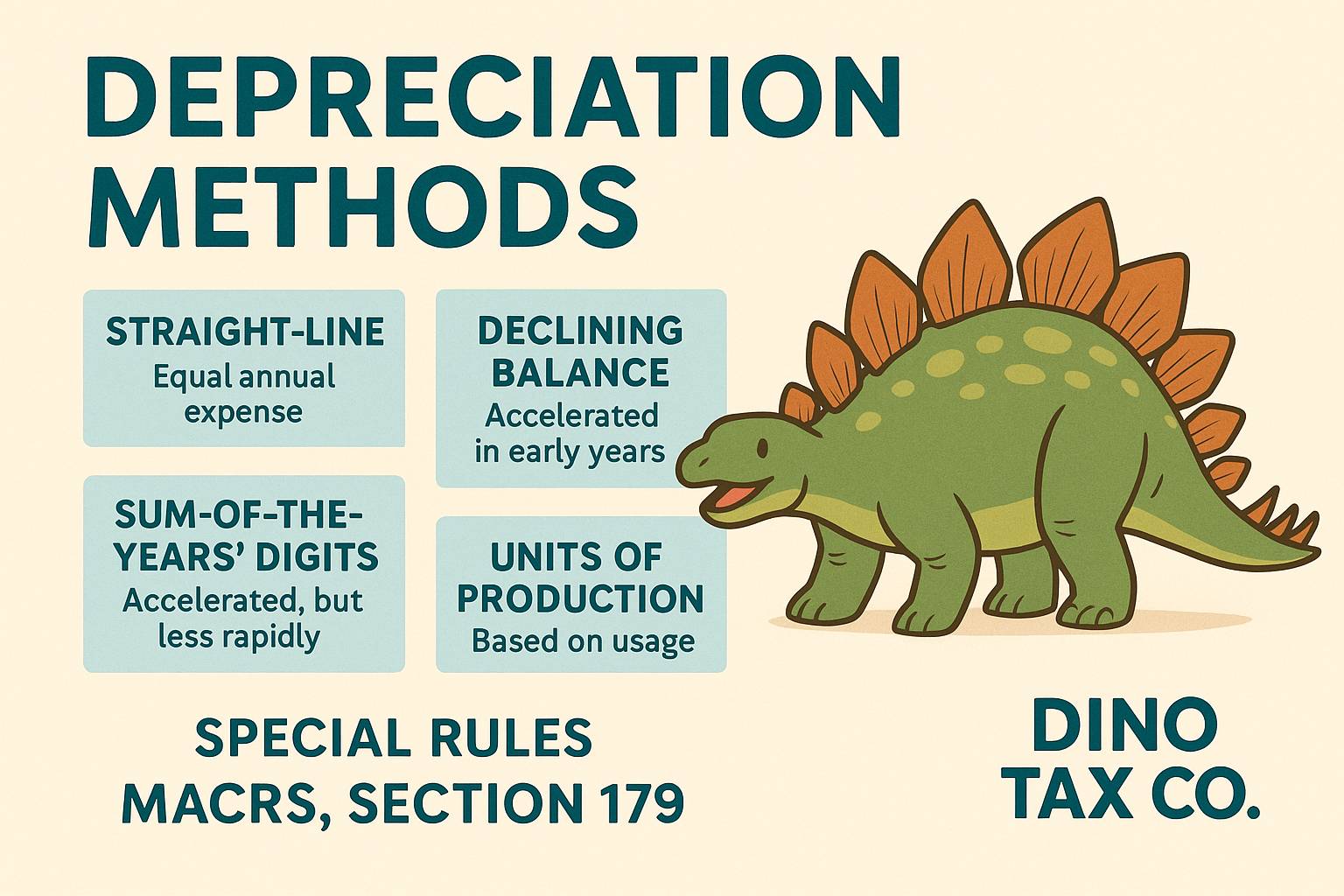
1. Straight-Line Depreciation
This is the simplest method. You deduct the same amount every year over the asset’s useful life.
- Best for: Assets that wear out evenly, like office furniture.
- Pros: Predictable and easy to calculate.
- Cons: Doesn’t reflect assets that lose value faster in the early years.
2. Declining Balance (Accelerated) Depreciation
With this method, you deduct a larger amount in the early years and smaller amounts later on. The most common version is the Double Declining Balance (DDB).
- Best for: Technology or vehicles that lose value quickly.
- Pros: Matches real-world loss of value.
- Cons: More complex to calculate.
3. Sum-of-the-Years’ Digits (SYD)
This accelerated method uses a fraction based on the asset’s life. Like DDB, it front-loads depreciation but with a smoother curve.
- Best for: Similar to DDB, but when you want a middle ground between straight-line and highly accelerated methods.
4. Units of Production
Instead of time, this method is based on actual use (like miles driven or units produced).
- Best for: Manufacturing equipment.
- Pros: Matches depreciation to actual wear and tear.
- Cons: Requires detailed usage tracking.
5. Special Rules (MACRS and Section 179)
- MACRS (Modified Accelerated Cost Recovery System): This is the IRS’s standard system, and most businesses will use it. It’s a blend of accelerated methods, with predefined recovery periods.
- Section 179 Deduction: Lets you deduct the entire cost of qualifying assets in the year you buy them, up to annual limits.
- Bonus Depreciation: Another way to immediately deduct a large portion of certain asset costs.
Choosing the Right Method
The method you pick can impact cash flow, tax liability, and financial reporting. Straight-line might be perfect for a small office, while a construction company may benefit from accelerated methods or Section 179 deductions.
At Dino Tax Co, we help clients navigate tax matters ranging from unfiled returns to IRS letters and levies and everything in between with clarity and confidence. If you’d like guidance on your situation, schedule a consultation today. Call or text (713) 397-4678 or email davie@dinotaxco.com. We’re here to help you take the next step.

Leave A Comment