Many taxpayers lend money to friends or family members believing that, if the borrower never repays the loan, they will at least receive a tax deduction. Unfortunately, federal tax law is much stricter than most people realize.
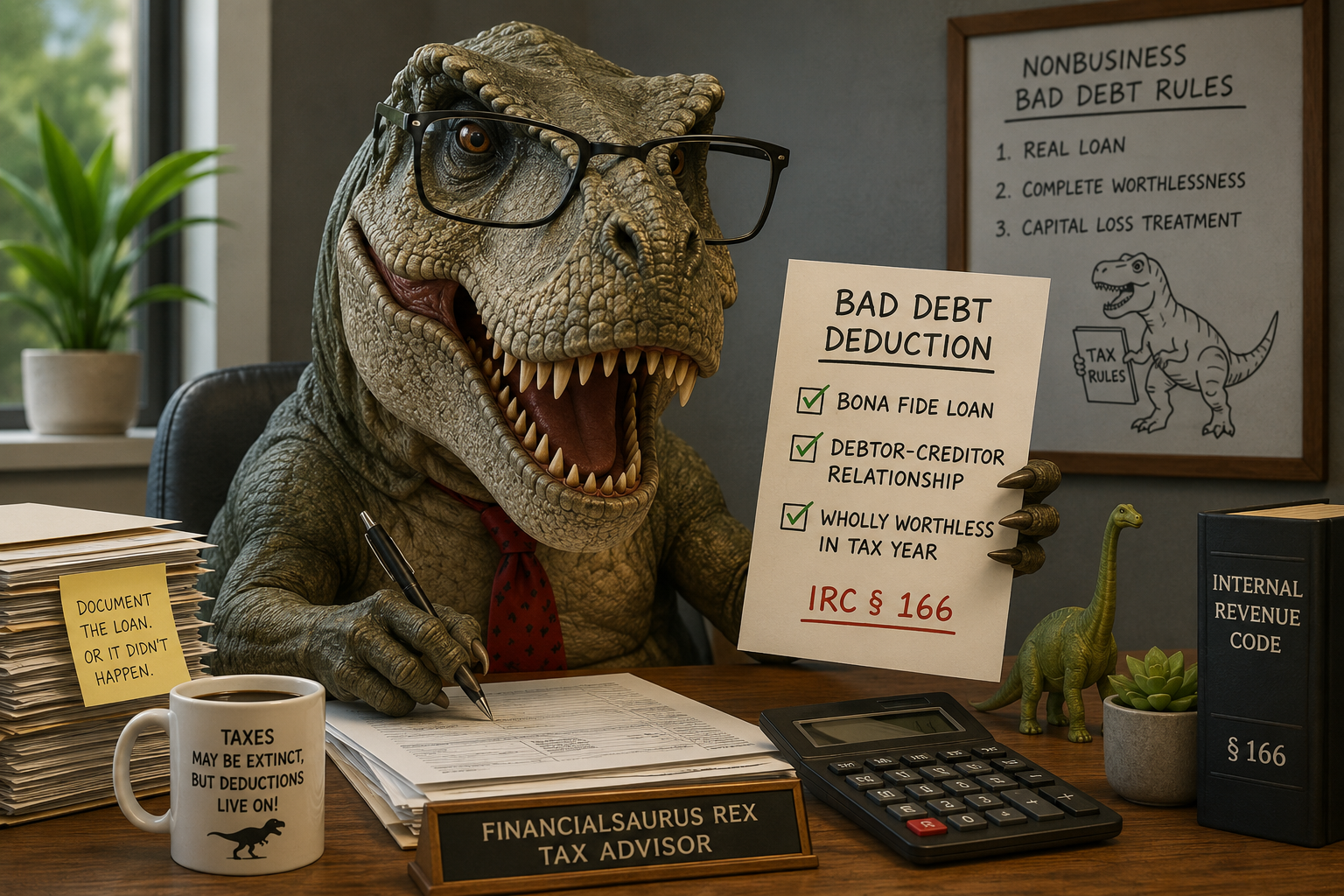
In many situations, a personal loan that goes unpaid does not produce an ordinary tax deduction. Instead, the debt must satisfy several legal requirements before it qualifies as a nonbusiness bad debt under Internal Revenue Code § 166.
What Is a Nonbusiness Bad Debt?
A nonbusiness bad debt is generally a debt that:
- arose from a genuine debtor-creditor relationship,
- was not connected to the taxpayer’s trade or business, and
- became completely worthless during the tax year.
Unlike business bad debts, nonbusiness bad debts are treated as short-term capital losses, regardless of how long the debt existed.
IRC § 166(d)(1)(B) provides:
“In the case of a taxpayer other than a corporation… where any nonbusiness debt becomes worthless within the taxable year, the loss shall be considered a loss from the sale or exchange, during the taxable year, of a capital asset held for not more than 1 year.”
This distinction is extremely important because capital loss limitations often prevent taxpayers from immediately deducting the full amount.
Treasury Regulations Require a Genuine Loan
The IRS does not simply accept that money transferred between relatives was a loan.
Treasury Regulation § 1.166-1(c) states:
“Only a bona fide debt qualifies for purposes of section 166.”
The regulation further explains that:
“A bona fide debt is a debt which arises from a debtor-creditor relationship based upon a valid and enforceable obligation to pay a fixed or determinable sum of money.”
In other words, there must have been a real expectation of repayment when the funds were advanced.
Gifts Are Not Bad Debts
One of the most common mistakes occurs when parents help adult children financially.
If the facts suggest the transfer was actually a gift, there is no deductible bad debt—even if everyone originally hoped repayment might occur.
The IRS often considers factors such as:
- Written promissory notes
- Fixed repayment dates
- Interest provisions
- Collection efforts
- Partial repayments
- The borrower’s financial condition at the time of the loan
Without evidence of an actual loan, the deduction may be denied.
The Debt Must Become Completely Worthless
A taxpayer cannot deduct a debt merely because repayment appears unlikely.
Treasury Regulation § 1.166-5(a)(2) provides:
“A nonbusiness debt shall be allowed as a deduction only for the taxable year in which the debt becomes wholly worthless.”
Partial worthlessness generally is not deductible for nonbusiness bad debts.
Instead, taxpayers must wait until there is no reasonable expectation of recovering any remaining balance.
Examples may include:
- Bankruptcy with no expected distribution
- Death of the borrower with no estate assets
- Exhausted collection efforts
- Expiration of the statute of limitations combined with lack of collectibility
Why This Matters
Because nonbusiness bad debts become short-term capital losses, taxpayers generally use them:
- against capital gains, and
- if losses exceed gains, up to the annual capital loss deduction limitation, with unused losses generally carrying forward to future years.
Many taxpayers mistakenly expect a full ordinary deduction, which is generally unavailable for nonbusiness bad debts.
Practical Documentation Tips
If you intend to make a substantial personal loan, consider maintaining documentation such as:
- a signed promissory note,
- repayment schedule,
- interest provisions where appropriate,
- records of payments,
- written collection attempts if default occurs, and
- documentation establishing when the debt became worthless.
Good documentation often determines whether the IRS recognizes the transaction as a loan or recharacterizes it as a gift.
Final Thoughts
Helping family members financially is common, but the tax consequences depend heavily on how the transaction is structured. Simply transferring money is rarely enough to establish a deductible bad debt. Taxpayers should document loans carefully and understand that even qualifying nonbusiness bad debts receive capital loss treatment rather than ordinary loss treatment.
If you have questions about documenting loans, claiming bad debt deductions, or responding to an IRS examination involving IRC § 166, professional tax advice can help ensure your deduction is properly supported.
At Dino Tax Co, we help clients navigate tax matters ranging from unfiled returns to IRS letters and levies and everything in between with clarity and confidence. If you’d like guidance on your situation, schedule a consultation today. Call or text (713) 397-4678 or email davie@dinotaxco.com. We’re here to help you take the next step.

Leave A Comment