
Smartphones have blurred the distinction between business and personal life.
An employee may use the same phone to answer a client’s call, respond to a work email, check a personal text message, call a family member, and look at directions on the drive home.
If the employer pays for that phone, does the employee have taxable income?
Surprisingly, the answer may be no.
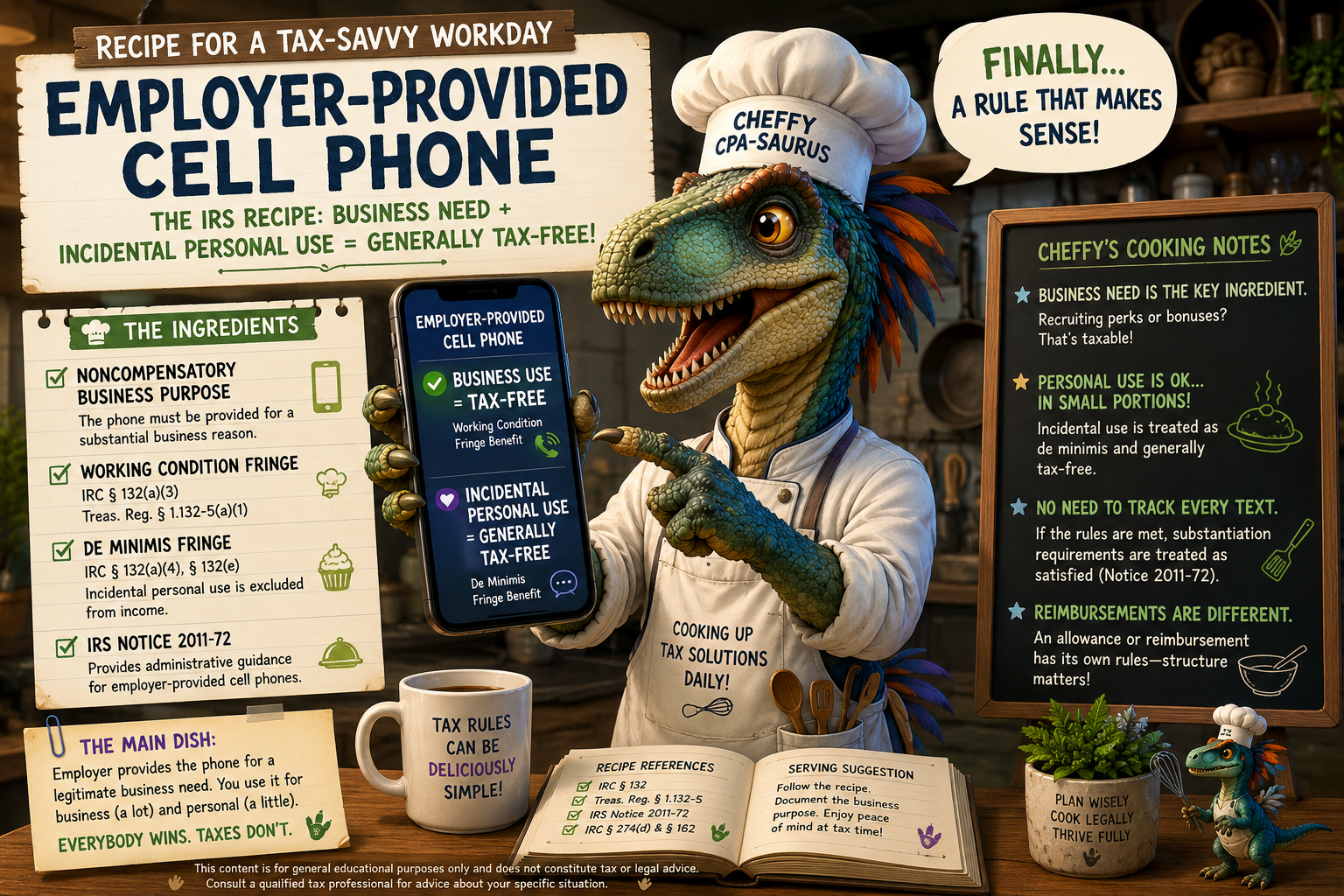
Federal tax law contains a favorable rule for employer-provided cell phones. When an employer provides a cell phone primarily for legitimate business reasons rather than as additional compensation, the business use of the phone can generally be excluded from the employee’s gross income as a working condition fringe benefit.
Even better, the IRS generally treats the employee’s personal use of that same employer-provided phone as a de minimis fringe benefit that is also excluded from income.
Understanding why requires looking at IRC § 132, the Treasury Regulations, and IRS Notice 2011-72.
What Is a Working Condition Fringe Benefit?
Internal Revenue Code § 132(a)(3) excludes a “working condition fringe” from gross income.
IRC § 132(d) generally defines a working condition fringe as property or services provided by an employer to an employee to the extent that, if the employee had paid for the property or services, the payment would have been deductible under IRC § 162 or § 167.
Treasury Regulation § 1.132-5(a)(1) states:
“Gross income does not include the value of a working condition fringe.”
The regulation then defines the term:
“A ‘working condition fringe’ is any property or service provided to an employee of an employer to the extent that, if the employee paid for the property or service, the amount paid would be allowable as a deduction under section 162 or 167.”
That rule covers considerably more than cell phones.
It establishes the general principle that an employer can provide certain property or services needed for an employee’s work without automatically creating taxable compensation.
Employer-Provided Cell Phones Receive Special Treatment
Cell phones have a particularly interesting history under federal tax law.
For many years, cellular phones were classified as “listed property” under IRC § 280F. Listed property is subject to heightened substantiation requirements because it is the type of property that can easily be used for both business and personal purposes.
That treatment became increasingly awkward as cell phones evolved from relatively unusual equipment into ordinary tools of modern employment.
Congress eventually removed cell phones from the definition of listed property.
The IRS then issued Notice 2011-72, providing administrative guidance for employer-provided cell phones.
The basic rule is remarkably favorable.
When an employer provides an employee with a cell phone primarily for noncompensatory business purposes, the employee’s business use of the phone is treated as a working condition fringe benefit.
That means its value generally does not have to be included in the employee’s taxable income.
What Is a “Noncompensatory Business Purpose”?
The phrase “noncompensatory business purpose” is important.
The tax exclusion is not intended to allow an employer to disguise additional compensation as a supposedly business-related cell phone.
Instead, there must be a substantial business reason for providing it.
Examples include an employer’s need to contact an employee during work-related emergencies.
Another example is an employee who must remain available to communicate with customers while away from the office.
An employer may also have employees who regularly communicate with customers, vendors, or coworkers in different time zones and therefore need to be available outside normal business hours.
These are legitimate operational reasons for providing a phone.
The analysis is different if the employer provides an expensive phone merely as a perk, recruitment incentive, morale booster, or substitute for additional wages.
The IRS specifically distinguishes those compensatory purposes from legitimate noncompensatory business purposes.
Personal Use of the Employer’s Phone Can Also Be Tax-Free
Here is where the rule becomes particularly useful.
Suppose an employer gives an employee a phone because the employee legitimately needs it for work.
The employee inevitably uses the phone occasionally for personal purposes.
Does the employer have to determine the value of every personal call, text message, or minute of data usage and add that amount to the employee’s W-2?
Generally, no.
Under Notice 2011-72, the IRS treats the value of personal use of an employer-provided cell phone as a de minimis fringe benefit when the phone was provided primarily for noncompensatory business purposes.
That brings another portion of IRC § 132 into play.
IRC § 132(a)(4) excludes de minimis fringe benefits from gross income.
IRC § 132(e) generally describes a de minimis fringe as property or services whose value, considering the frequency with which similar benefits are provided, is so small that accounting for the benefit would be unreasonable or administratively impracticable.
That makes intuitive sense in the smartphone context.
Requiring an employer to determine precisely how much of an unlimited monthly cell-phone plan was attributable to an employee texting a spouse or checking personal email would produce enormous administrative complexity for very little tax revenue.
The IRS therefore provides a much simpler approach.
Employees Generally Do Not Need to Track Every Business and Personal Call
Ordinarily, the working-condition-fringe rules can involve substantiation requirements.
Treasury Regulation § 1.132-5(c)(1) provides:
“The value of property or services provided to an employee may not be excluded from the employee’s gross income as a working condition fringe, by either the employer or the employee, unless the applicable substantiation requirements of either section 274(d) or section 162 (whichever is applicable) and the regulations thereunder are satisfied.”
The regulation further explains in § 1.132-5(c)(2):
“The substantiation requirements of section 274(d) are satisfied by ‘adequate records or sufficient evidence corroborating the [employee’s] own statement’.”
If those ordinary requirements applied rigidly to smartphones, an employee could potentially face the absurd task of documenting countless individual communications.
Notice 2011-72 provides administrative relief from that problem for qualifying employer-provided cell phones.
When the requirements of the notice are satisfied, the IRS treats the relevant substantiation requirements as satisfied for purposes of the working-condition-fringe exclusion.
Thus, employees generally do not have to maintain a detailed log separating every qualifying business call from incidental personal use merely to obtain the exclusion.
Example: Employer Provides a Phone to an On-Call Employee
Suppose a plumbing company employs a service manager who handles after-hours emergencies.
The employer provides the manager with a smartphone because customers may need to reach the manager at night or on weekends.
The manager also occasionally uses the phone to text family members, check personal email, or make personal calls.
The employer has a substantial noncompensatory business reason for providing the phone: the manager must be reachable for work-related emergencies.
The business use can therefore generally qualify as a working condition fringe benefit.
The incidental personal use can generally qualify as a de minimis fringe benefit.
The employer does not ordinarily need to calculate the value of every personal text or telephone call and add that amount to the employee’s taxable wages.
Example: Employer Gives an Executive a Phone as a Bonus
Now change the facts.
Suppose a company has no particular business need to provide its executive with a new smartphone.
Instead, the company tells the executive:
“You had a great year, so we’re buying you the newest phone.”
That is a very different arrangement.
The phone is being provided as compensation or a reward rather than primarily for a noncompensatory business purpose.
Calling the phone “business equipment” does not necessarily transform compensation into a tax-free fringe benefit.
The purpose for which the employer provides the property matters.
What About Reimbursing an Employee’s Personal Cell Phone Bill?
Another common situation occurs when an employee owns the phone and pays the cellular bill personally, while the employer reimburses some or all of the expense.
That situation should not automatically be treated as identical to an employer purchasing and providing a phone directly.
The tax treatment of reimbursements can depend on the nature of the arrangement and whether the reimbursement satisfies the applicable business-expense reimbursement rules.
Treasury Regulation § 1.132-5 itself illustrates the distinction between providing property and simply handing employees cash.
Section 1.132-5(a)(1)(v) states that:
“A cash payment made by an employer to an employee will not qualify as a working condition fringe unless the employer requires the employee to—”
The regulation then imposes conditions concerning the employee’s use and substantiation of the payment.
Employers therefore should not assume that an unrestricted monthly “phone allowance” automatically receives exactly the same treatment as a qualifying employer-provided business phone.
The structure and purpose of the arrangement matter.
Employer-Provided Phones Are Different From Personal Employee Expenses
There is another distinction worth emphasizing.
A rule allowing an employer to provide a tax-free working condition fringe does not necessarily mean an employee can personally buy the same item and claim an income-tax deduction.
The federal tax rules governing employee business expenses and employer-provided fringe benefits are separate questions.
This distinction is especially important because taxpayers frequently assume:
“If my employer could deduct it, I can deduct it.”
Tax law does not always work that way.
The proper analysis depends on who paid the expense, why it was incurred, the taxpayer’s employment status, and which particular Code provisions apply.
The Rule Also Applies to Similar Telecommunications Equipment
The IRS guidance is not necessarily confined to an old-fashioned cellular telephone used primarily to make calls.
For this purpose, the IRS includes similar telecommunications equipment within its discussion of employer-provided cell phones.
That makes the rule considerably more relevant in a world where smartphones function simultaneously as phones, email devices, cameras, authentication devices, messaging platforms, calendars, and portable computers.
The underlying question remains the same:
Why did the employer provide the device?
If the primary reason is a substantial, noncompensatory business need, the tax rules can be quite favorable.
Why the Employer’s Purpose Matters So Much
This is ultimately a substance-over-label problem.
An employer cannot necessarily take something that is really compensation and transform it into a tax-free fringe benefit simply by calling it a “business phone.”
Conversely, a phone does not become taxable compensation merely because the employee receives some incidental personal benefit from having it.
The tax system recognizes that modern business equipment frequently produces some unavoidable personal benefit.
The key distinction is between providing equipment because the employer needs the employee to have it and providing something valuable because the employer wants to compensate the employee.
A Small Tax Rule With Enormous Everyday Application
The tax treatment of employer-provided cell phones is a good example of how federal tax law sometimes adapts to ordinary economic reality.
Technically, an employee who receives valuable property or services from an employer begins with the broad principle that compensation and fringe benefits may constitute gross income unless an exclusion applies.
But IRC § 132 creates several important exceptions.
For qualifying employer-provided cell phones, two of those exceptions can work together.
The employee’s business use may be excluded as a working condition fringe.
The employee’s incidental personal use may be excluded as a de minimis fringe.
The result is refreshingly practical: when an employer genuinely needs an employee to have a cell phone for business, federal tax law generally does not require the employer and employee to perform an accounting exercise every time the employee sends a personal text message.
For millions of workers carrying employer-provided phones every day, that small administrative rule can prevent an ordinary workplace tool from becoming an unnecessary tax headache.
This article is for general educational purposes only and does not constitute individualized tax or legal advice.
At Dino Tax Co, we help clients navigate tax matters ranging from unfiled returns to IRS letters and levies and everything in between with clarity and confidence. If you’d like guidance on your situation, schedule a consultation today. Call or text (713) 397-4678 or email davie@dinotaxco.com. We’re here to help you take the next step.

Leave A Comment